Review: The Impossible Knife of Memory by Laurie Halse Anderson

20140120-071025.jpgLaurie Halse Anderson is a master at speaking the language of teenage angst and turmoil. She gave us Speak, a story about a teenage girl traumatized to the point of becoming mute. In Wintergirls, she addresses the self-destructive behaviors of eating disorders and cutting. And then there’s her latest endeavor…

Seventeen-year-old Hayley and her dad, Andy, have relied on just each other for years. A veteran of wars in both Iraq and Afghanistan, Andy suffers from debilitating PTSD while Hayley does her best to hold their fragile lives together. As is the case in many of these situations, she becomes the parent while her dad struggles to simply survive each day. She can’t separate the happy memories from the bad ones, so she represses them all. They’ve traveled across the country as he attempted to escape his demons. When that doesn’t work, they settle back in their hometown where Hayley enrolls in school for the first time after being homeschooled for so many years. Enter Finn, a quirky, lovable soul who takes her as she is, secrets and all. There’s also Gracie, Hayley’s one remaining friend from her childhood. Hayley’s reluctant to allow anyone access to her private world even as it crumbles around her. Andy sinks deeper and deeper into his own private hell as each day passes. He drowns himself in alcohol and drugs in an attempt to silence the battle going on in his head. The rare moments of lucidity and normalcy are just enough to keep Hayley from reaching out for help. She, meanwhile, is facing her own struggles outside of home. A bright student who loves to get lost in her books, she’s also extremely unmotivated and spends much of her school days in either the counselor’s office or detention. The story follows Hayley as she tries to save her dad and, as a result, herself as well. Along the way, she realizes that her friends’ picture perfect lives aren’t as happy as they seem; every family has its secrets. Hers are just a little more dangerous.

Laurie Halse Anderson has once again written a story that plunges you deep into the hearts and souls of her characters. Hayley is a flawed teenager who could be any of us. She has a dry, witty sense of humor and a strong sense of survival for both she and her dad. She is wise beyond her years and is loyal to a fault. Hayley isn’t one of the pretty, popular girls but she’s the one I’d most like to be friends with. I enjoyed this book tremendously and finished it in a day. It’s another great young adult book from an amazing author.

~ Thalia

Buy it Now: The Impossible Knife of Memory

Review: Crazy by Han Nolan

20131230-191409.jpgYoung adult book about teen drama-check. Mental illness as the main focus-check. Been there, done that, right? Except this one is insanely (bad choice of words, I know) different. In this refreshingly unique novel the tables are turned and this time it’s a child who has to cope with his parent’s mental illness.

Jason can’t remember a time when his life wasn’t overshadowed by his dad’s odd behavior. Going as far back as age six when his dad tried to bury him alive “to protect him”, it’s always been a part of their lives. However, when Jason’s mom dies unexpectedly things begin to rapidly deteriorate. She was the one who always held things together, and without her their lives start to spin out of control. Money is tight, food is scarce, and their house is falling apart. Despite his best efforts to hold things together and keep their way of life a secret, his grades and behavior at school are being affected. When he’s sent to group therapy, he finds comfort in an unlikely group of friends who are living with family issues of their own. In a short span of time he’s forced to confront his own feelings of grief at his mother’s death, guilt at not being able to protect his dad, and fear that he, too, is losing his mind. He has to learn to accept help from others and to be a kid again after being the adult in his family for so long. There’s a hospitalization and a confrontation with social services before everything is finally resolved. Along the way, Jason is kept company by running commentary from a cast of characters he has created in his mind to help him cope with his dysfunctional life.

This was an amazing story from beginning to end. It could have been another run-of-the-mill story of teen angst and drama but Han Nolan inserts humor and emotion into every page. The ever-present conversation going on in Jason’s head has the potential to be annoying and distracting but instead is entirely believable, and you can see how that’s his one little lifeline to sanity. He’s never really confronted his grief at losing his mother, and he eventually realizes he harbors a lot of anger as well for being forced into the position he’s in. The author skillfully captures the voice of a young teenage boy in the reversed role of being the parent. It’s also a safe read for teenagers without speaking down to them, which is hard to come by these days. Five stars for me!

~Thalia

Buy it Now: Crazy

Review – Code Name Verity by Elizabeth Wein.

11925514My fellow muses are probably going to banish me to the stables for this, but I have to begin this review by stating that YA fiction is not a genre that I read or enjoy…. Yes, I can feel the death stares permeating through my skin as I type! However, I like a challenge, and so I decided to read a YA, yes you read correctly, a YA novel called Code Name Verity. Actually, truth be told, I listened to it on audio, rather than read, but same difference!
Frustratingly, this is one of those novels where you can’t give too much of a synopsis due to spoilers, so this will be brief: WWII, two young women, one of whom is captured in Nazi occupied France. The novel begins with “Verity” writing a confession in a prison cell, and thus begins the tale. Through this epistolary novel, Verity tells a story of Queenie and her friend, Maddie, and their experiences being stationed together during the war. The story is split between 1st person narrations (Verity’s experience in the prison), 3rd person narration (the story of Queenie and Maddie’s friendship) and the narration is primarily shared between Verity and Maddie.
Listening on audio, you get the added advantage of hearing different voices for different characters. This helped a lot, and was appropriate due to the style in which the novel is written. As I mentioned above, I don’t usually read YA, but this one was so different. It had the usual components of a YA novel – very little swearing, not really any sexual situations, and no gratuitous violence. However, this one presented certain situations in an extremely frank and honest manner, without sensationalising and gratuitousness: E.G., the interrogation scenes were very frightening and horrific, but they were honest, and didn’t feel like they were exploiting it. It’s hard to explain, but I felt like it read as an adult book, but at the same time, it would still be appropriate for an older teenager.
If you do decide to pick this story up, which I highly recommend that you do, be prepared to find yourself laughing, possibly crying, gasping, cringing, and recoiling. It will hit on most of your emotions and it will leave you asking yourself what if? What if you were captured by an enemy agent? Would you divulge crucial secrets? Would you do anything to survive? Would you break? Elizabeth Wein has written a fresh, unique and interesting WWII story that is brutal, honest, emotive, and effective. Do yourself a favour and read this gem of a novel before some big film studio ‘effs it up and makes a piss poor adaptation.
Enjoy ~ Pegasus
Code Name Verity (Edgar Allen Poe Awards. Best Young Adult (Awards))

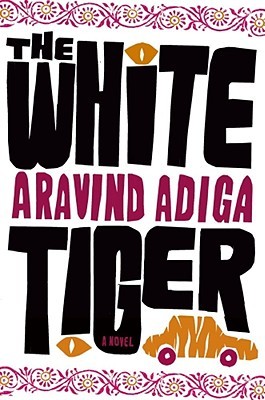
Review: The White Tiger by Aravind Adiga

a“The White Tiger” is a written confession from an Indian driver who murders his employer. It is told with matter-of-fact nonchalance by Balram Halwai. A man who grew up in the slums of India, “overcame” his birth status, became a #1 driver, a murderer, and finally an employer himself.

What can one say about a book such as this? I look at the some of the reviews and I wonder how it can have such a low rating. Is it because people are turned off by the matter-of-fact tone of Halwai? Are they disenchanted with the unsaid social commentary of India? Are they disgusted with the story that Halwai tells? Are they dissatisfied with “justice” in the world Adiga paints? Are they waiting for the author to tell them what to think? Are they waiting for Halwai to justify his actions? To show some redeeming quality, allowing you to forgive him? Are they the type that think every novel should have a beginning, a middle and an end? Do they expect happily ever after?

Here’s the thing….This might be Adiga’s story….it might also belong to Halwai….one can say it even belongs to all of India…but the thing is…this is the reader’s story as well. What you take from this story is what you put in to it. Aravind Adiga is young author…but he’s smart enough to know that sometimes the best novels are the ones left to the reader to decide. Some travesties don’t need pointed out. It might seem that Halwai has no feelings or is two dimensional…but this is his life. He’s not painting a pretty picture…he’s just laying out the facts. Adiga is the one who is leaving it up to you, the reader, to sort through these facts.

So, once you’re born into the social caste system of India, are you ever *really* able to move from one to the other? Should one be resigned to his/her own fate? Do we follow the customs of generations, even if they are the very same customs that bind us to future failures? Must we follow the way it has always been done, even if that way ensures us that no new path can be forged? Do we never question how things are, simply because they are the way things have always been? Does Halwai really have no feelings about right and wrong? Are is it that he is just so bone weary tired of it all? Does he really not care? Or is he just overcome with so much feelings of hopelessness?

What about nature and nurture? How does that play into how we justify our actions? Can one really blame society for that which we become? Is it possible to justify our actions in our own minds by blaming the limits our society puts upon us?

How can one even begin to change the history of the past? How corrupt does a government need to be before a nation lose all hope for any type of change? Can a person who benefits from a broken social system ever really want to be the one who fights to make it right? Will we ever learn to trust one another? Can someone who has nothing ever be satisfied with that? Should they?

Can an outsider ever *really* understand?

Yes, the questions I have after reading this novel are more than I had before. Will I spend countless hours debating this? Will I look at the world a bit differently now? yes. yes. yes…..yet….Adiga did not ask a single one of these questions. Halwai did not point out a single one either. It’s a brilliant writer that can evoke so much from a reader….that can sit back and not try to lead you down the path to self discovery. That doesn’t feel the need to blurt out the answers…..I thank him for his discipline….

How can I not love a book like this? Yes, it’s ugly and it’s dirty. Yes it’s unfair. Yes, it’s true….it has no beginning…nor even a middle…and certainly no ending. It has no one clear victim. It has no single hero. This is life….pure and raw….ugly and bleeding….helpless and innocent….corrupt and hopeless….

So tell me….what are you going to do about it? Turn the other cheek, give it a bad rating, and hope to forget all about it? Go on then….I dare you to….

Until next time….

Urania xx

Buy it now The White Tiger

Review: The Whole Golden World by Kristina Riggle

20140101-075407.jpgIt’s easy enough to write about difficult topics, especially if it’s fiction. Child abuse, incest, murder, school shootings…they’ve all been covered at one time or another with varying degrees of success. But to be able to do so in a way that doesn’t make the reader cringe and push the book aside is no easy feat. Kristina Riggle has done just that with this intriguing novel.

The story centers on the inappropriate relationship between seventeen-year-old Morgan and her math teacher, TJ Hill. Morgan has always been considered mature for her age and seems wise beyond her years. A gifted musician who also writes poetry, she finds herself tiring of the usual teenage drama all around her. A beautiful young woman,she’s nonetheless extremely self-conscious about a scar on her face resulting from a childhood injury. TJ is one of the most popular teachers at the high school. He has an easy rapport with his students. He’s also under a huge amount of stress at home as he and his wife, Rain, continue a barrage of medical treatments as they attempt to conceive a child. Morgan provides a shoulder for him to lean on as he deals with this pressure. She, in turn, thrives on the attention from a wise, mature older man. When their relationship is discovered and charges are filed, Morgan finds herself sitting opposite her parents in the courtroom as she defends the man she believes to be the love of her life. The question is, was Morgan the victim of a manipulative older man or is she a delusional teenager obsessed with her teacher?

If these were the only two characters in this story it would still be a winner. But the author has added a cast of supporting characters that provide enough of a story on their own. There’s Joe, Morgan’s gruff but loving father who just also happens to be the assistant principal at the high school. Dinah, Morgan’s mother, thrives on being involved in her children’s lives but also runs a successful, popular coffee hangout for the local teens. At the same time, she must stay on top of Morgan’s younger twin brothers, Jared and Connor who suffer academic and behavior issues as a result of a difficult birth. And of course there’s Rain, TJ’s supportive but unsuspecting wife who bears a striking resemblance to Morgan.

A story with this many characters always has the potential for being a big confusing mess. Not in this case. Riggle successfully ties everything in to the main storyline while at the same time keeping the reader’s interest spread all around. The story alternates between Morgan, TJ, and to a lesser degree Rain while at the same time keeping us interested in what’s going on with everyone else. As I read this book, I found myself connected to all of the characters, not just Morgan and TJ. There’s no question that this type of relationship is never appropriate, regardless of the student’s age. Those in such positions of power bear a huge responsibility for staying within the boundaries. This story deals with the legalities and morality of such a situation while at the same time showing how other friends and family members are affected. Five stars for me!

~Thalia

Buy it Now: The Whole Golden World

Review: The January Wish by Juliet Madison

20140102-152247.jpg The January Wish is women’s fiction, family drama, and romance all rolled into one — and set in Australia. I loved the plot: Sylvia reunites with the daughter she gave up for adoption 18 years ago. And I enjoyed the subplots: Sylvia breaks up with one guy and falls in love with another; Sylvia’s daughter experiences young love; small-town citizens support each other personally and in business.

I didn’t like the characters, though. I thought they were a little wishy washy, a little boring, a little unrealistic in their behavior. For example, we hear repeatedly (too many times, really) about Sylvia’s reserved and organized life – from her wardrobe to her car to her office – and then she lets loose dancing on the bar at a bachelorette party (hen night). That just doesn’t make sense to me. That kind if thing happens more than a few times. Later in the book, two conservative characters decide to play strip Scrabble. It just didn’t seem natural based on what the author told us about this couple… So why add it?

The unnatural dialogue hurt my ability to enjoy the book as well.

“Yes, she mentioned how she quite enjoys her acupuncture sessions now… But how anyone could enjoy having tiny needles stuck into their skin is beyond me!” Sylvia managed a friendly laugh.

Even if someone were to say those exact words, I imagine them said under the breath or out of the side of the mouth, not exclaimed and followed by laughter (and this is spoken by the reserved, boring gal).

The characters and dialogue just weren’t up to par and really hindered any enjoyment of the plot. The writing was so verbose and descriptive at times, I was distracted from the plot. (Um, recurring mentions of Mr. Benson — why? How did this relate to the story?) I started skipping paragraphs just to find something related to the plot or subplots.

All in all, I didn’t like the writing, characters or dialogue. Unfortunately, they took away too much from a beautifully thought-out plot.

— Calliope

Buy it now The January Wish

Review – The Death of Bees by Lisa O’Donnell

15818333In 2013, the age of Instant Messaging, texting, face-iThingy, etc…, how many of us really know or speak to our neighbours anymore? Would you notice if two teenage girls were living with abusive and irresponsible parents? Would you notice if those parents were to disappear? Well, luckily for you, Lisa O’Donnell explores this conundrum in her debut novel, The Death of Bees. Set in present day Glasgow, O’Donnell presents the reader with Nelly and Marnie – two teenage girls growing up in some of the worse conditions imaginable. Their situation gets exponentially more precarious when their parents die, and they are suddenly left to fend for themselves. Don’t worry, I didn’t just give away a spoiler – you know this happens right from the get go. Marnie and Nelly’s quest for survival from both death, and the social services is the main focus of the story and along the way, we meet a host of interesting characters that intersect with Marnie and Nelly.
O’Donnell’s narrative is split between 3 people, and each one provides a different view point of events. At first it was a little jarring to read through the eyes of Nelly, as she has a very particular way of speaking. However, you soon get used to it and it really provides character. The amount of time spent on each narrative is perfect; you never once feel like you’ve been spending too long reading as one character. The language used by the characters is not pretty – but then life isn’t always pretty – it is honest, sparse, and real.
If you’re looking for your next unique read, I would highly recommend this one. It runs the gauntlet of emotions (it will even make you feel physically sick at one point!) and does not let up, but at the same time, it isn’t depressing for the sake of being depressing. There is light amongst these characters and it shines just as often as it is put out. It is a relatively short read, so if you can read it in one sitting, or even two, then that would be the way to do it so that you don’t lose the rhythm of the narration.
You can get this fresh, unique and honest story here – The Death of Bees: A Novel

~ Pegasus.

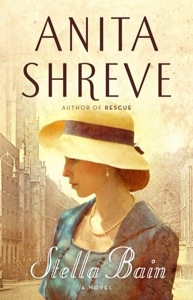
Review: Stella Bain by Anita Shreve

20131225-214734.jpgHistorical fiction is a very popular genre these days. From “The Book Thief” to “The Help”, authors all around are creating beautiful works of literature that seamlessly mesh historical facts with spellbinding fictional story lines. This one could have been part of that elite group.

The story begins with an unknown woman waking up injured in a battlefield hospital in France. The year is 1916, and World War I is underway. The woman identifies herself as Stella Bain but can remember nothing more than working as a nurse’s aid and driving an ambulance. Whether this is true or not is anyone’s guess. Driven by the need to find out the truth about her past, she feels the urge to travel to London where she senses the truth must lie. When she arrives in London, she is taken in by a kind physician and his wife. With their help, she is able to recover her memory. As such, she discovers what she was unknowingly hiding from. Without giving too much of the story away, there follows a legal battle which forces “Stella” to confront her past.

I had high hopes for this book, having enjoyed other works by Anita Shreve. This one started out in dramatic fashion and held my attention through about two-thirds of the story. Then it just gradually faded away for me. The author is a skillful writer who weaves a beautiful story full of historical details. The problem for me was that it just died out towards the end. I felt like the ending was rushed and a huge chunk of time was skipped. I get a great deal of satisfaction from knowing what happens to “my” characters at the end of a book and this one didn’t do it for me. It’s not a bad story, but I felt that it could have ended on a better note.

~Thalia

Buy It Now: Stella Bain

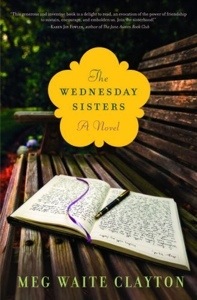
Review: The Wednesday Sisters by Meg Waite Clayton

20131227-125151.jpg It’s the late ’60s and five ladies who hang out with their children at a park in Palo Alto strike up a friendship. Ally, Kath, Brett, Linda and Frankie have different marriage situations, different backgrounds, and varied financial statuses, but they all want the same thing: to be noticed and appreciated.

The women decide to start writing — and sharing their work on Wednesdays at the park. As they navigate the world of literary critique without hurting feelings, they learn to love each other despite any shortcomings in their talent or personalities.

I just loved this book. It reminded me of my relationship with my sister and my best friends – always honest, sometimes abrupt or annoyed, always loving. These ladies were strong and independent, even as housewives in the 1960s. But they intelligently chose to rely on each other when a husband cheats, a pregnancy ends in miscarriage, self-esteem tanks, an old injury leaves physical and emotional scars, and breast cancer threatens to take a mother from her children. The women weren’t perfect. They judged each other silently, and supported each other out loud. But I guess you don’t really care what someone thinks of you when you’re suffering; you care how people treat you.

I think I mostly loved this book because the friendship was real – flawed and imperfect, but they always figured out what to do to move on from their mistakes. I laughed and cried at these five women sharing a relationship this special, while raising children, taking care of their homes and husbands, and dealing with the tragedies life threw at them.

The ending? Think Johnny Carson, blatant hilarity, and true love for our fellow man. I mean, woman.

–Calliope

Buy it now The Wednesday Sisters

Review: Wings of Glass by Gina Holmes

20131208-165741.jpgThis wonderful, touching story by Gina Holmes crosses boundaries and fits into so many categories. It’s a story about domestic abuse that also has a Christian theme running underneath. It’s a story about friendship and the support we get from others who care about us. It’s also a story of suspense that leaves you wondering what’s going to happen from one page to the next.

Penny is just barely 17 when she becomes smitten with Trent Taylor, a handsome and charismatic farmhand hired by her father. Being young and naive, Penny is easily swept off her feet. The abuse begins almost as soon as Penny leaves home with Trent. He’s both physically and emotionally abusive. The hitting is just a small part of the way he terrorizes Penny. Cut off from her family, Penny is dependent on Trent for everything and never knows when something is going to set him off. Like most abused women, Penny begins to believe that she deserves the abuse and her self-esteem is eroded more and more each day. Then an accident turns the tables and Trent is suddenly dependent on Penny. Is it possible that Trent has changed and is trying to be the husband she deserves? It’s at this point that Callie Mae and Fatima enter Penny’s life. Along with providing a friendship she didn’t know was possible, the women also challenge Penny to look within herself and examine the way she’s living. She’s also conflicted by her strong faith when she wrestles with the decision of whether she should leave Trent or “stand by her man”.

This is the second book I’ve read by Gina Holmes and I’ve loved both of them beyond belief. The author creates such strong, believable characters that you almost believe she’s writing about her own personal experiences. That’s not to say I had warm and fuzzy feelings for Penny. I found her infuriating and couldn’t believe she kept going back to Trent and falling for his lies. I just wanted to reach into the book and scream at her. How could she be so stupid? Couldn’t she see that this was bound to end badly? But the fact that I felt such strong emotions for the character just speaks volumes as to what a great story this is. This was one I couldn’t put down, and I couldn’t get this story out of my head even after I finished it. Anytime a story pulls me in that deeply it’s a must-read!

~Thalia

Buy it Now: Wings of Glass