Review: The Children’s Train: Escape on the Kindertransport by Jana Zinser

51Xzv+KHYsL._SX323_BO1,204,203,200_If you asked me what my preferred genre is, I’d be hard pressed to narrow it down to just one. However, historical fiction ranks at the top of that list. I love a book that tells a great story while also teaching me a bit of something new. That’s why some of my favorite books of all time include The Book Thief and The Orphan Train. It’s for that very reason that this book by Jana Kinser caught my eye.

Nazi Germany was a terrifying place for all, but especially for young children. Their safe, secure world was turned upside down as they were targeted for nothing more than being Jewish. Homes and livelihoods were destroyed, families were separated, loved ones lost their lives. All because of something they had no control over. But there was hope for many of the children in the form of selfless volunteers who risked their lives to help these children escape and have a chance at a somewhat normal life.

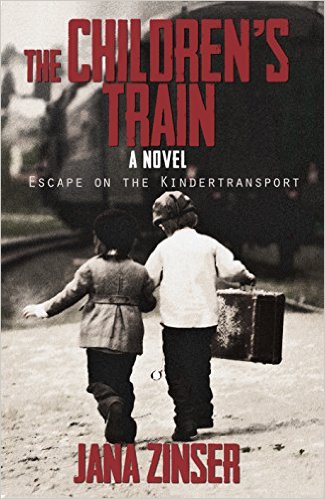
For the most part, this story centers on young Peter. He and his family have a happy, secure life in their comfy little apartment above their butcher shop. That all comes crashing down when the Nazis invade their small town taking over everything. Suddenly, being Jewish is a crime, punishable by death even. Peter and his family find themselves without a home along with many others. When the chance to escape presents itself, Peter and his younger sister take it. On the Kindertransport they go, off to a better life. Their journey is not without risks, though, as the war rages on.

There are other characters, of course. And their stories are just as important. There’s young Eva, the apple of Peter’s eye. She has a ticket on the train to freedom but her older brother has a different idea. Stephen and Hans are sent on the train to safety by their respective families. And then there are the tragic stories of those left behind, children who didn’t get a seat on the train as well as adults not able to escape.

This was an incredibly engaging story for me because I had no idea such a thing existed. The Kindertransport was something new that I’m now highly motivated to learn more about. For that reason alone, it was a book I just couldn’t put down. The characters and storylines were good as well, although I did feel that many of the deaths were described too matter-of-factly. Still, a great story about an interesting subject!

~Thalia

Buy It Now: The Children’s Train: Escape on the Kindertransport

Review: Outlander by Diana Gabaldon

IMG_0269.JPG
It’s so difficult to ponder this book after reading it that I have to hurry and write the review so I can forget about the book.

Outlander is about Claire, a English woman from the 1940s, pulled into an adventuresome, fun, dangerous, romantic quest in 18th century Scottish Highlands.

I loved every second of 90% this book: Horseback riding through the forests, stereotypical Scottish dialogue, ripped clothing, filth, the challenges of being a female who knows medicine and healing, lots of rough men stealing and working and saving people… An arranged marriage that was full of unspoken love, family ties of numerous clansmen, illegitimate children, crime, detention and escape, and of course a really really bad villain with an ancestral tie to Claire’s husband. What’s not to love in this beautiful saga?!

One thing ruined the entire book for me. The ENTIRE book. I’m talking about making the book go from 5 stars to 2. It nauseated me and left a bad taste in my mouth. The chapter was gratuitous and over the top in my opinion. There was a day of rape. I can accept that as part of the story. I can’t tolerate the retelling of the day-long rapes to one’s spouse, including not only every physical detail but EVERY anguishing psychological and emotional detail. I just don’t believe that any spouse would or could tell their loved one what Gabaldon wants me to believe Jamie told Claire.

Had I known that was coming I would have completely skipped the chapter, pleasantly read the very end, and given Outlander 5 stars.

The one scene ruined the entire book for me. How disappointing.

-Calliope

buy OUTLANDER

Review: Lucky Us by Amy Bloom

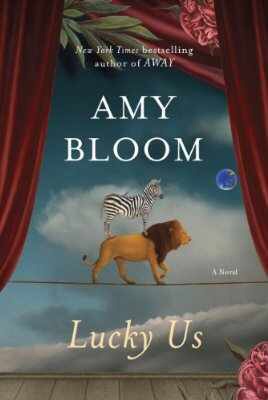
20140728-154355-56635463.jpg There’s nothing quite like having a sister to help you through life. In Lucky Us, the expectation is that Iris will take care of her little sister Eva after their loved ones abandon them. But it is Eva who holds together the relationship, with dim hope and quiet strength. The sisters embark on an adventure like no other, opening their eyes and their lives to worldliness and shallow sophistication. They try – but fail – to piece together a family. They try again. And again.

Lucky Us is about losing a family and finding a family. It’s about the damage that a mother and father can do and undo. It’s about making a life out of nothing but the kindness of strangers, and then recognizing that kindness as the only love you’ll ever know.

This book is historical fiction, set during the 1940s, referencing the war and its horrors, and illustrating the stunning commonalities among Jews, Germans, and Japanese. I don’t even like historical fiction, but I was taken in by the human facet of the decade. It read so much like contemporary fiction that I forgot what decade I was in. The crafting of this book is exceptional, the format perfect for the story, and the writing is tight, with every substantial paragraph meaning more than you think.

Lucky Us is hopeful. Eva shows how a young woman can endure much – maybe not with joy but with grace – and find acceptance for the life she has.

I found Eva so impressive, gracious, and strong. The grand finale in Eva’s life is the return of two loved ones. Adding them to the one who never left is Eva’s happily-ever-after finally coming to fruition. Lucky, indeed.

–calliope

Note: Amy Bloom will give a free talk about LUCKY US on Friday, August 1, at 7p.m. at RJ Julia Booksellers in Madison, Connecticut.

buy LUCKY US

The Anatomy Lesson by Nina Siegal

18077844For those of you that love historical fiction, this may be a book for you. I’m personally not a huge historical fiction fan, and I generally hold everything up to a few favourites I’ve read in the past. Not fair? You’re right, it isn’t but unfortunately I can’t help it!
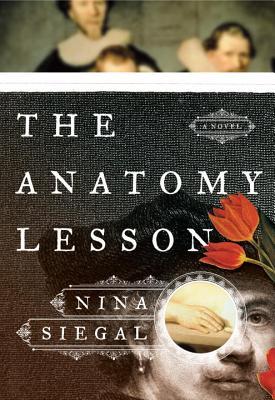
The Anatomy Lesson is set in Holland in the 1600’s. It follows several characters around the time in which Rembrandt was commissioned to paint one of his most famous pieces: The Anatomy Lesson of Dr. Nicolaes Tulpe. Each of the characters in the story all have something to do with, or influence the events around this painting. The general premise of this book is interesting and it would have made a really good novel. However, in my opinion, there were too many flaws that didn’t allow me to enjoy it as much as I should have.
First, let’s talk about the structure. The story is initially divided into two narratives. One set in 17th century Holland, and the in modern day Holland. The latter narrative revolves around an art historian who is examining the painting and trying to repair it back to its former glory. To me, this narrative really wasn’t necessary. It did not add anything to the plot.
The other thing that bothered me (and it might not bother others), was the constant change of tense and personal narrative. One minute someone is speaking in 1st person and the next 3rd person. I’m sure there was a literary/personal reason for this, but it just grated on me.
This is a short review, because as you can probably tell, I didn’t really enjoy it. However, if you enjoy historical fiction, and want something different than the usual 16th century royal family sagas, then give this one a go, and form your own opinion. There is definitely potential…

~ Pegasus.

The Anatomy Lesson: A Novel

Review: Stella Bain by Anita Shreve

20131225-214734.jpgHistorical fiction is a very popular genre these days. From “The Book Thief” to “The Help”, authors all around are creating beautiful works of literature that seamlessly mesh historical facts with spellbinding fictional story lines. This one could have been part of that elite group.

The story begins with an unknown woman waking up injured in a battlefield hospital in France. The year is 1916, and World War I is underway. The woman identifies herself as Stella Bain but can remember nothing more than working as a nurse’s aid and driving an ambulance. Whether this is true or not is anyone’s guess. Driven by the need to find out the truth about her past, she feels the urge to travel to London where she senses the truth must lie. When she arrives in London, she is taken in by a kind physician and his wife. With their help, she is able to recover her memory. As such, she discovers what she was unknowingly hiding from. Without giving too much of the story away, there follows a legal battle which forces “Stella” to confront her past.

I had high hopes for this book, having enjoyed other works by Anita Shreve. This one started out in dramatic fashion and held my attention through about two-thirds of the story. Then it just gradually faded away for me. The author is a skillful writer who weaves a beautiful story full of historical details. The problem for me was that it just died out towards the end. I felt like the ending was rushed and a huge chunk of time was skipped. I get a great deal of satisfaction from knowing what happens to “my” characters at the end of a book and this one didn’t do it for me. It’s not a bad story, but I felt that it could have ended on a better note.

~Thalia

Buy It Now: Stella Bain

Review: Margot by Jillian Cantor

20131101-184210.jpgYou’d be hard-pressed to find an adult who hasn’t heard of Anne Frank. For many of us, her diary was likely required reading in high school. And some may even remember that Anne had an older sister, Margot. But how many people have considered what Margot’s perspective on their situation might have been? I’m guessing not more than a handful if any. I sure didn’t before reading this book.

This imaginative, and at the same time, historical novel by Jillian Cantor asks the reader to do just that. And, stretching your imagination even further, believe for the duration of the book that Margot was actually able to escape from Auschwitz and eventually make her way to America. The story opens with Margot, now known as Margie, living in Philadelphia several years after the war has ended. She has completely erased her identity and past as she tries to assimilate into a Gentile, American lifestyle. Fear is an overriding theme of Margie’s day to day life: fear of her Jewish heritage being uncovered, fear of being the target of an anti-Semitic attack, fear of having to face her conscience and the guilt she suffers daily at having survived while her sister did not.

To complicate matters further, the big screen version of her sister’s diary is now the talk of the town. Nobody close to Margie suspects the double life she is leading. Not her closest friend Shelby, and certainly not her boss, Joshua, who Margie develops feelings for in spite of her carefully constructed outer shell of a life. Margie is also haunted by memories of her teenage love, Peter, and the dilemma of whether he, too, may have survived and escaped to America.

Having never read anything by Jillian Cantor, I was immediately intrigued by the premise of this story. I’m always interested in a good historical fiction novel, especially one that deals with this era in history. As I read this book, I had to keep reminding myself that this was not a factual account of the Frank family’s experiences. The author does that great of a job pulling us into the story. The characters are well-developed, especially Margie who evoked such feelings of sympathy from me. My heart broke for this lonely young woman living such a solitary life with no family to comfort her other than her cat.

Margot will definitely go on my list of favorite historical fiction books. It offers a fresh take on an unfortunate time in our history. Five stars for me!

~ Thalia

Buy it Now: Margot: A Novel